Chapter 1 Introduction
Life threatening emergencies do occur in the practice of dentistry. They can happen to anyone-a patient, a doctor, a member of the office staff, or a person who is merely accompanying a patient.
Morbidity
A total of 4309 respondents from all 50 states of U.S.A. and 7 Canadian provinces reported 30,608 emergencies over 10 years in combined findings of two surveys from United States. 96.6% of the respondents answered positively to the following question:"In the past ten years, has a medical emergency occurred in your dental office?" (Doctors used their own definitions of emergency situations.)
About 50% of these emergencies were listed as syncope. A notable portion (25.35%) of reported emergencies were related to the cardiovascular, central nervous, and respiratory systems, and were thus all potentially life threatening.
Although most situations arose while the patient was undergoing treatment, other developed whole the patient was not in the dental chair. A survey of medical emergencies arising in a U.S. dental school over an 8.5-year period reported that 20% events occurred in persons who were not patients at the time (e.g., faculty, students, persons accompanying patients).
Although any medical emergency can develop in the dental office, some are seen more frequently than others. Many such situations are stress related or involve preexisting conditions that are exacerbated when patients are placed in stressful environments. Stress-induced situations include vasodepressor syncope and hyperventilation, whereas preexisting medical conditions that can be exacerbated by stress include most acute cardiovascular emergencies, bronchospasm (asthma), and seizures. The effective management of pain and anxiety in the dental office is therefore essential in the prevention and minimization of potentially catastrophic situations.
Drug-related adverse reactions make up another category of life-threatening situations that occur more often than dentists expect. The most frequent are associated with local anesthetics.Psychogenic reactions, drug overdose, and drug allergy are just a few of the problems associated with the administration of local anesthetics. The overwhelming majority of such “drug-related” emergencies are stress related (psychogenic); however, other reactions (overdose, allergy) represent responses to the drugs themselves. Most adverse drug responses are preventable.
It is found that only 1.5% of the emergency situations occurred in the waiting room in a medical emergency situations evaluation in dental offices in Japan. The greatest percentage of medical emergencies, 54.9%, took palce during the administration of local anesthesia, which, according to both patients and doctors, is the most stressful procedure performed in the dental office. About 22% of these emergencies developed during dental treatment while 15% occurred in the dental office after completion of treatment. Most such emergencies were orthostactic hypotension or vasodepressor syncope.
Another survey of 1029 dentists in Britain demonstrated that most emergencies (36.7%) occurred during dental treatment; 23.1% occurred before the start of treatment; 20.1% after the administration of local anesthetic; and 16.4% after completion of the dental procedure. Approximately 3% of the events in England and Wales and 2.2% of those in Scotland affected persons who were not actually undergoing dental treatment. This group included persons who were accompanying patients, passersby, and five members of the dental staff, including a dentist and a technician.
It is found that 65% of cases developed during two types of dental care—tooth extraction (38.9%) and pulp extirpation (26.9%). In the British paper, 52.2% of events occurred during conservative dental treatment and 23.5% occurred during dentoalveolar surgery. Although information regarding the specific cause of the problem is not always available, these emergencies most likely occurred when the patient experienced sudden, unexpected pain.
Death
Most emergency situations that occur in dental practice are defined as potentially life threatening. Only on rare occasions does a patient actually die in a dental office.
Failure to properly recognize and treat clinical signs and symptoms can turn a relatively innocuous situation into an office tragedy. Adequate pretreatment physical evaluation, combined with proper use of the many techniques for pain and anxiety control, can help prevent many emergencies and deaths.
Each year in the United States, 10% of all nonaccidental deaths occur suddenly and unexpectedly in relatively young persons believed to be in good health—thus the term “sudden, unexpected” cardiac arrest. The cause of death most often is a fatal cardiac dysrhythmia, usually ventricular fibrillation. Preventive measures cannot entirely eliminate this from happening so we, the dental profession, must be prepared. successful outcomes are possible when the dental “team” acts quickly to recognize and to manage the situation.
Emergencies/deaths developed “after [the patient had left] the dental office.”
However, not all such deaths occur within the confines of the dental office. The stress associated with dental treatment can potentially trigger events that result in a patient’s demise days after treatment. In the Southern California Society of Oral and Maxillofacial Surgeons survey, 10 such incidents were reported.17 Of particular interest are 3 deaths secondary to myocardial infarction and 1 secondary to cerebrovascular accident. Another death reportedly was related to an allergic reaction to propoxyphene hydrochloride, which the dentist had prescribed for postoperative pain relief. In Matsuura’s study in Japan, 5.5% of all medical emergencies developed “after [the patient had left] the dental office.”
Risk factors
- Increased number of older patients
The life expectancy of humans is increasing steadily. Although many older patients appear to be in good health, the dental practitioner must always be on the lookout for significant subclinical disease. Cardiovascular function and efficiency decrease as part of the normal aging process. In some instances, decreased efficiency manifests itself as heart failure or angina pectoris, but overt signs are not always apparent. When subjected to stress (pain, fear, anxiety, high humidity, extremes of heat and cold), the cardiovascular system of the older person may not be able to meet the body’s demands for increased oxygen and nutrients, a deficit of which may lead to acute cardiovascular complications such as life-threatening dysrhythmias and anginal pain. Situations that might have proved innocuous to a person at a younger age may well prove to be harmful 20 years later. The aging process involves both physiologic and pathologic changes that may alter the patient’s ability to successfully adapt to stress.
Dental practitioners have begun treating more patients older than 60 years who have retained most of their natural dentition. These patients require the full range of dental care—periodontics, endodontics, crowns, bridges, restorative work, implants, and oral surgery. Because of their ages and the possibility of preexisting physical disabilities, many of these patients are less able to handle the stress normally associated with dental treatment. This reduced stress tolerance should forewarn the dental practitioner that older patients are at greater risk during dental treatment, even in the absence of clinically evident disease. In addition, the dental practitioner must take every step to minimize this risk
- Medical advances
Many patients who were confined to their homes or who needed to rely on wheelchairs and were unable to work and unlikely to seek dental care now live relatively normal lives because of drug therapy and surgical technique advances. These medical advances are truly significant. They also mean that dental practitioners must manage the oralhealth needs of potentially at-risk patients, many of whom have chronic disorders that are merely being controlled or managed, not cured. McCarthy termed these persons “the walking wounded, accidents looking for a place to happen.”
- Longer appointment
Dental care can be stressful for the patient, for the doctor, and for staff members, and longer appointments naturally create more stress. Medically compromised patients are more likely to react adversely under these conditions than are healthy individuals, but even healthy patients can suffer from stress, which can create unforeseen complications. Stress reduction has become an important concept in the prevention of medical emergencies.
- Increased drug use
Drugs play an integral role in contemporary dental practice. However, all drugs exert multiple actions; no drug is absolutely free of risk.
41% of patients over 60 years were taking one or more medications regularly. Dental practitioners must take
special care to anticipate and recognize complications related to either the pharmacologic actions of a drug or the complex interactions between commonly used dental drugs and other medications.
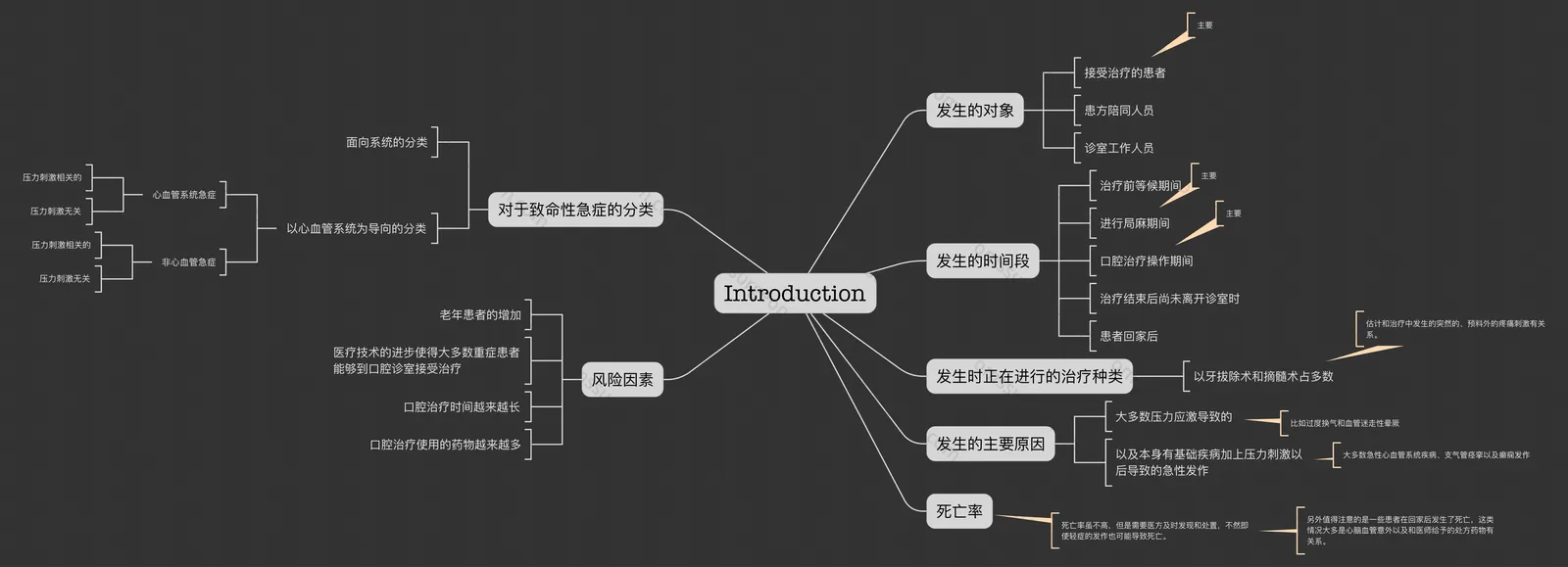
Classification of life-threatening situations
The traditional approach has been the systems-oriented classification, which lists major organ systems and discusses life-threatening situations associated with those systems.
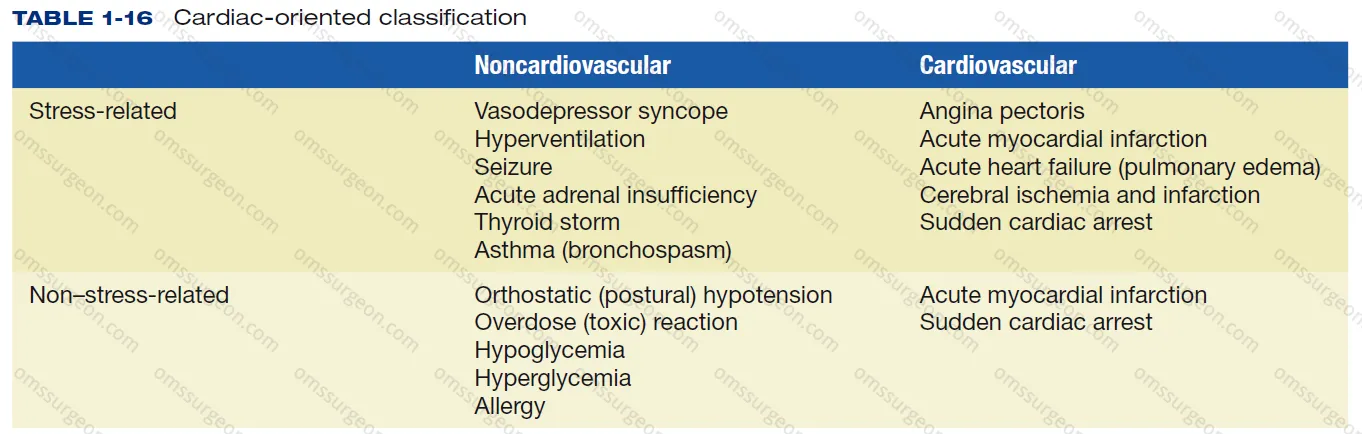
Although a systems approach is often considered suitable for educational purposes, from a clinical perspective it is lacking. A second classification method divides emergency situations into two broad categories—*cardiovascular and noncardiovascular emergencies, which both can be broken down further into stress-related and non–stress-related emergencies.
Table. Cardiac-oriented classificaion of mediacal emergencies in the dental office !
Cardiac-oriented_classification_of_medical_emergencies
总结
Chapter 3 Preparation
前面一章的内容,无论是询问患者的一般情况和病史还是体格检查和生命体征检测,基本算是医学的基础知识,牙科医生在这方面的知识可能会有所欠缺,但是这些对颌面外科医生都是必备的技能和意识。本章包括的内容如急救设施的装备、急救小组的角色分配和日常演习等,医学院校内大多没有相关要求,更多的是在医院内才相关内容的学习;美国的颌面外科医生是和麻醉医生一起做实习医生的,所以美国的颌面外科医生即使自己开业,也可以有进行镇静乃至全麻操作的资质,所以可能对于医学紧急事件有更强的处理能力,这一点也是和国内颌面外科医生培养方式上不同的地方。所以本章内容对于颌面外科医生牙医尤其是开业牙医都有很大的参考意义。由于我国开业医生中牙医占有很大比例,而且层次也各不相同,所以尽量将要点翻译成中文,这对于其他专业的开业医生应该也有参考意义。
通过前述德的询问、检查以及对病人进行分级处理,也并不能完全阻止医学紧急事件的发生,所以具有时刻准备处理医学紧急事件的能力也是必不可少的中。对于牙科诊室而言,因为医生无法从病人进门到其离开的整个过程中都陪伴着患者,所以无论是医生还是其他工作人员(包括前台接待)都应该具备识别和处理这些紧急事件的能力。
工作人员
整个诊所或者工作室的工作人员都应该对于识别可处理紧急事件有所准备。对此至少包括如下要求:
- 培训中包括基础生命支持(Basic life support)技能、识别和处理医学紧急事件的的能力以及定期演习
- 易于识别和获取的急救求助电话,储备急救药物和器械
培训
所有人员都需要通过培训获得识别和处理紧急事件的能力。每年对急救医学课程更新应该包括所有的内容,而不是仅仅更新基本生命支持方面。
基本生命支持
基础生命支持(如CPR)的操作是按照P(体位)➡️C(循环)➡️A(气道)➡️B(呼吸)➡️D(Definitive care)顺序进行。其中的D包括诊断、药物、除颤。大多数时候,药物治疗是下一阶段的事情。
除颤
有研究报告仅仅进行基础生命支持而没有及时进行除颤的抢救成功率不足5%。
高级生命支持的内容包括:
- 气道管理和通气(包括插管):Adjuncts for airway control and ventilation (including intubation)
- 心电监测和异常节律识别:Patient monitoring and dysrhythmia recognition
- 除颤和同步电复律:Defibrillation and synchronized cardioversion
- 心血管系统药物治疗:Cardiovascular pharmacology
- 酸碱平衡维持:Acid-base balance maintenance
- 静脉穿刺和建立静脉通道:Venipuncture
- 婴儿和新生儿复苏:Resuscitation of infants, including newborns
团队协作
尽管大多数急救操作可以单人完成,但是团队协作的效率会更高。急救团队至少由两到三人组成,并与先确定成员在紧急抢救中的角色。关于各角色的详细定义可以参考这篇文献1,简单对三个成员的抢救团队中各个角色描述如下:
1#号成员是首先发现患者的人,其职责如下:
- 立即对患者进行评估,并根据需要开始基础生命支持
- 一直陪伴着患者除非有人替换
- 同时通知其他人员,以激活抢救程序并获得帮助
2#号成员为第一个听到1#成员呼救的人,其职责如下:
- 立即携带急救药箱、便携给氧系统以及AED到达急救现场
- 平时负责每日检测便携式给氧系统,每周检测急救药箱以及AED
3#号成员一般作为建立血液循环支持的护士或者助手,根据情况需要,3号成员可以不止一个人。其基本职责包括:
-
如有需要,协助1#成员进行基础生命支持
-
检测生命体征
-
提供其他需要的任何支持,比如协助准备抢救药物、协助给药、协助摆放患者体位、松解患者衣领或皮带等
-
拨打医学急救中心电话求助
-
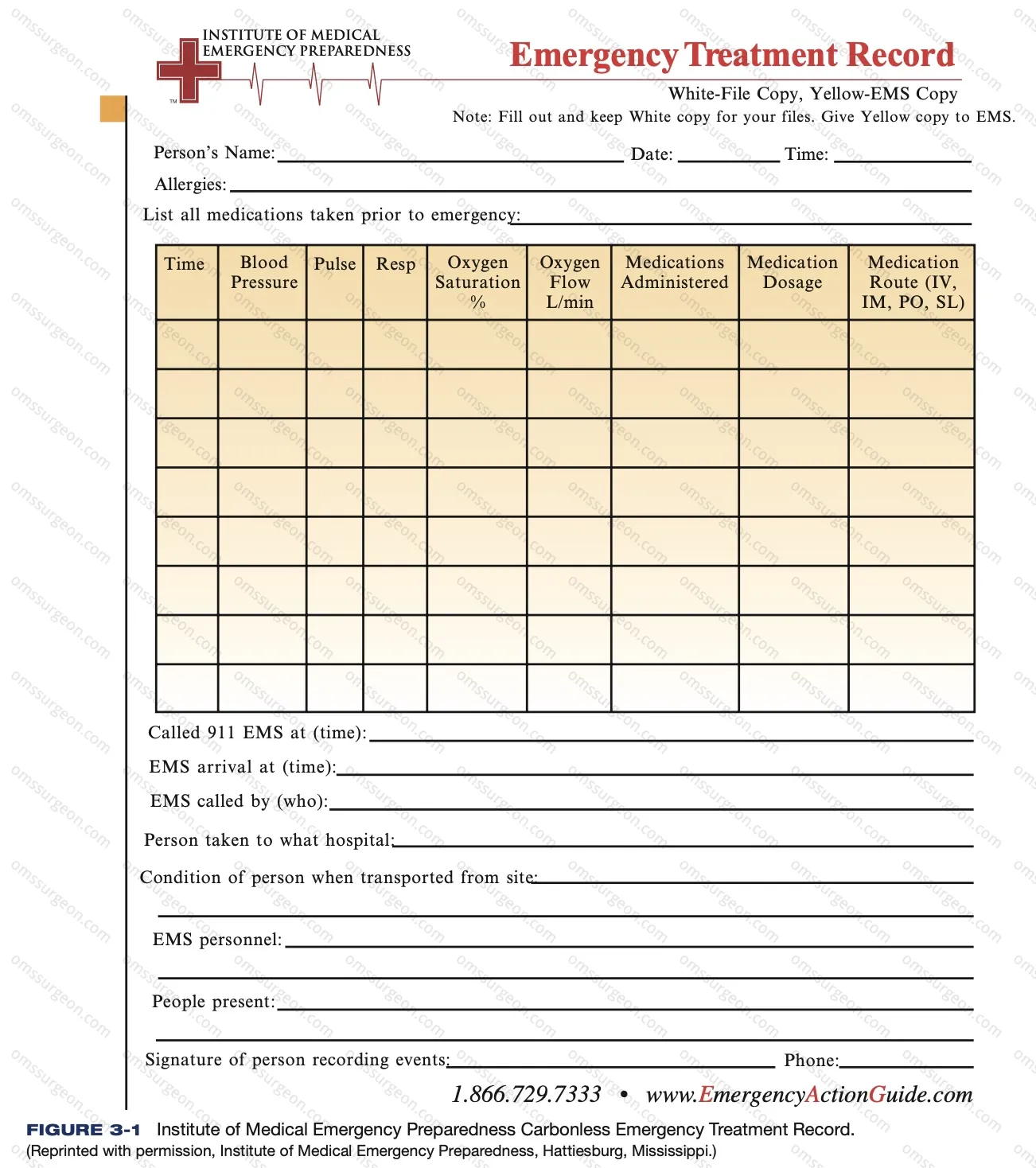
对抢救过程进行记录,包括患者生命体征、使用药物、患者对救治的反应等
-
迎接医学急救中心人员并将其引导到急救现场
-
对于团队人员,要求任何人都能在需要时随时承担起各个角色的功能。1#成员是事实上进行抢救的人员,所以需要由有能力的成员担任,到达现场后立即接过第一发现者的角色和功能。
急救演练
医学紧急事的发生没有规律性,发生几率也比较低,所以平时大多没有机会进行成分实战。所以要在紧急抢救时个成员合理有序高效的执行自己的角色功能,离不开平时的急救演练,这需要每年进行医学急救知识的学习,以及按照实际急救现场的情形定期演习。
寻求紧急救助
工作人员都应该熟知需要时向谁以及如何寻求紧急医学救助,比如最近的具有抢救能力的急救中心、120以及其他具有相关专业知识的专业人员(这点国内可能不好操作)。
求助人员应该保持冷静,并向救助人员提供其所需的任何信息,一般包括:
- 急救现场详细地址(诊所地址建议贴在电话旁)
- 呼救人员联系电话
- 何种紧急事件(如突发心脏病、车祸等)
- 需要救助的人数
- 患者具体情况
- 现场正在进行何种急救措施
- 其他救助人员需要知道的任何信息;求助者应当等救助人员无进一步询问后在其后挂断电话。
应该在现场救助人员认为有必要时或者无法确认时立即求助,避免任何犹豫。
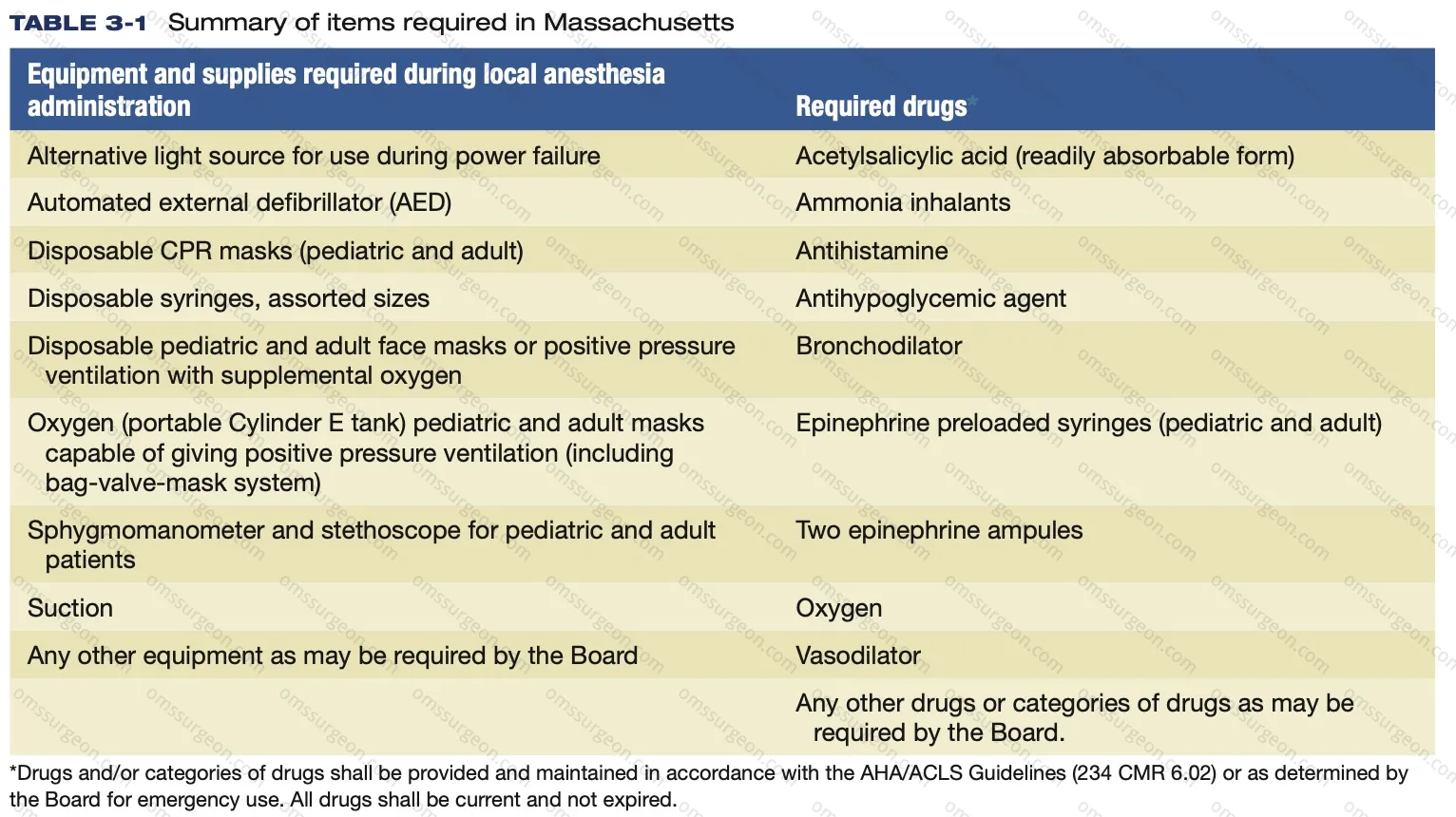
急救药物和设备
尽管药物治疗的重要性在大多数情况下需要让位给基础生命支持,但是在比如过敏反应(anaphylaxis)的情况下,及时给予肾上腺素则是患者存活的关键。
所有很多商业化的预先配备的紧急抢救药物箱,但是十分推荐医生根据个人情况对其进行完善。
团队人员均需要熟悉急救药箱位置及内部药物摆放。
急救药箱
尽量简单易于使用。在预备以及使用急救药箱时需要记住:
- 在急救现场,药物治疗并不是第一位的,基础生命支持才是:Drug administration is not necessary for the immediate management of medical emergencies (BLS is always implemented, as needed, first).
- 任何急救事件的最初处理永远是基础生命支持:Primary management of all emergency situations involves BLS.
- 不能确定的情况下,不要用药(怀疑过敏反应(anaphylaxis)除外):When in doubt, don’t medicate (there will be a very specific exception to this in the case of presumed anaphylaxis)
需要记住,在几乎所有的急救场景,基础生命支持都是最重要的才,记住基础生命支持(P→C→A→B→D)的顺序。即使在过敏反应现场,也是基础生命支持优先,然后尽早给予肾上腺素。
紧急医疗箱的组成
可以考虑将每种急救情形需要用的药物配备齐全,对于不熟悉的种类或者特定药物需要请教急救医学专业人员或者专业药师,但是最终配备的药物种类还是需要自己决定。
对于药物随附的说明书应当熟悉并妥善保存。
本书所建议的紧急医疗箱包括如下四个模块:
- 模块1:基础急救箱(必须急救药物和设备)
- 模块2:非紧急药物和设备
- 模块3:高级生命支持药物
- 模块4:解毒药物
每一模块的药物分为注射类和非注射类,并包括急救设备。
医生应该根据自己的急救水平配备相应的模块,急救医疗箱应该简单有效,急救设施的规格应该同时考虑到成人和儿童病人的情况。
注射类药物给药方式
理想的方式是静脉给药,起效时间一般在20-30秒。但是急救现场静脉穿刺往往难以成功,所以更常采用肌肉注射的方式给药,注射部位包括股外侧肌、上臂三角肌以及臀大肌外上象限(the upper outer quadrant of the gluteal region)。一般情况下肌肉注射起效时间在10分钟左右,血压降低的情况下肌肉灌注较差,起效时间更晚。在前述三个肌肉注射的区域,股外侧肌灌注最好,就上注射区域的安全性,为急救给药时的首选注射点。其次为上臂三角肌。臀大肌区域由于灌注差,加上儿童病人可能存在的并发症,在急救给药时选择往往不此注射区域。
需要急救的患者,尤其是心跳骤停的患者,全身灌注差,无论静脉给药还是肌注都无法起效,这也是药物治疗排在基础生命支持后面的原因之一。
有的时候静脉穿刺困难,但是患者已经插管,这个时候可以采用气管内给药,也具有很快的起效时间。
-
Haas D: Preparing dental office staff members for emer- gencies: developing a basic action plan, J Am Dent Assoc 141(Suppl):8S–13S, 2010.) ↩
本文仅代表作者个人观点,不代表作者所在单位立场。内容仅供医学教育参考,不构成诊疗建议;具体诊疗请咨询专业医生。详见免责声明。